
How to play Cricket
Cricket is one of the most popular dart games played around the world. Unlike traditional countdown games like 501, Cricket focuses on closing specific numbers and scoring points strategically. It’s easy to learn but offers a lot of depth for competitive players.
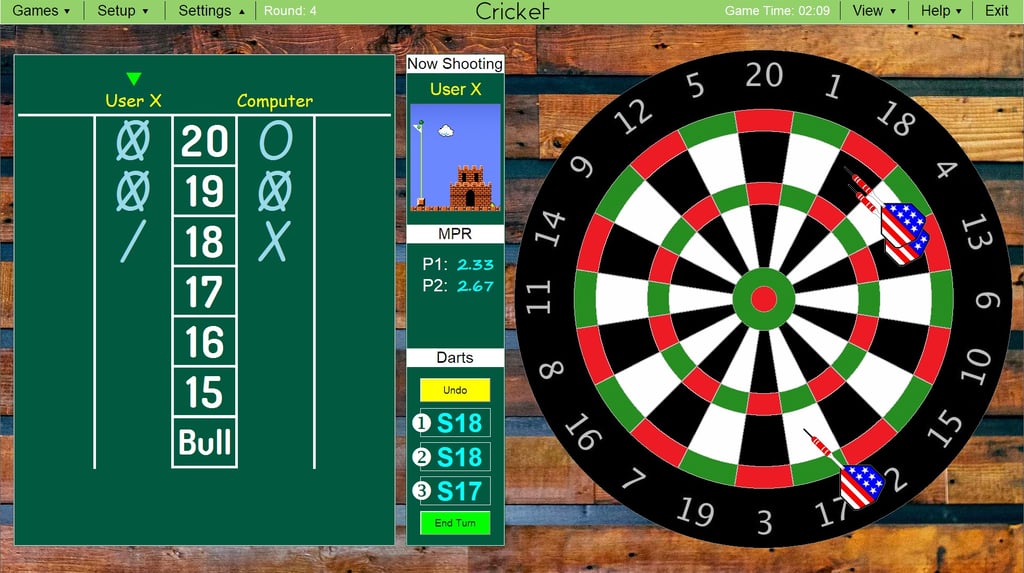
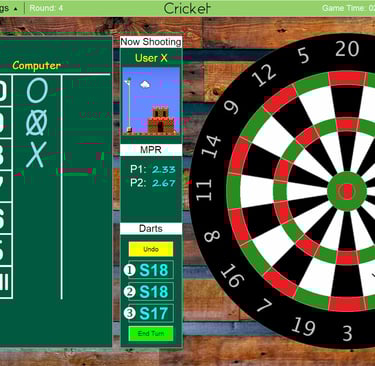
Cricket Scoreboard Example
A typical Cricket scoreboard lists the numbers:
20, 19, 18, 17, 16, 15, and Bull
Each player must hit each number three times to close it.
Scoreboards usually track marks like this:
/ = 1 hit
X = 2 hits
O (or circled X or /) = 3 hits (closed)
Basic Cricket Rules
1. Numbers Used
Players aim for these targets:
20
19
18
17
16
15
Bullseye
Only these numbers count in the game.
2. Closing a Number
To close a number, a player must score three hits on it.
Examples:
Single 20 = 1 hit
Double 20 = 2 hits
Triple 20 = 3 hits (closes the number immediately)
Once a player has three hits, that number is closed for them.
3. Scoring Points
If a player has closed a number but their opponent has not, they can score points.
Example:
Player A closes 20.
Player B has only 2 marks on 20.
Player A hits a triple 20.
They score:
60 points
Once both players close the number, no more points can be scored on it.
4. Bullseye Scoring
Most games count:
Outer bull = 25 (1 hit)
Inner bull = 50 (2 hits)
Some leagues count the inner bull as 2 marks, others as 1 mark worth 50 points.
5. Winning the Game
To win Cricket, a player must:
Close all numbers (20–15 and bull)
Have equal or more points than the opponent
If a player closes everything but is behind in points, they must keep scoring until they take the lead.
Strategy Tips for Cricket
Aim for High Numbers First
Most players start with 20s and 19s because they score the most points.
Block Your Opponent
If your opponent starts scoring on a number, try to close it quickly to stop their scoring.
Use Triples
Triples are extremely valuable in Cricket because they count as three marks or large points.
Popular Cricket Variations
Many leagues and casual players use variations of Cricket. Here are a few popular ones.
Cut-Throat Cricket
Cut-Throat Cricket is common in 3+ player games.
Instead of gaining points yourself:
Points are given to every opponent who hasn’t closed the number
Example:
You hit a triple 20 after closing it.
If two players haven’t closed 20 yet:
They each receive 60 points.
The winner is the player with the lowest score.
This version creates a lot of chaos and strategy.
No-Score Cricket
A simpler version often used for beginners.
Rules:
Players only try to close all numbers
No points are counted
The first player to close everything wins.
This variation is great for:
Practice
Training accuracy
Quick games
Random Cricket
In this variation, the numbers used change each game.
Instead of 20–15, players randomly select six numbers plus bull.
Example set:
14
12
11
9
7
5
Bull
This forces players to aim at parts of the board they normally ignore.
Why Cricket is So Popular
Cricket combines strategy, scoring, and defense, which makes it one of the most engaging dart games.
Players must decide whether to:
Score points
Close numbers
Block opponents
Because of this, every game can play out differently.
Using a Dart Scoring App
Keeping track of Cricket scoring manually can get confusing, especially with multiple players.
A dart scoring app like Dart Worx can automatically:
Track marks
Calculate points
Handle multiple players
Prevent scoring mistakes
If you play frequently, using a digital scorer makes games faster and more accurate.
✅ Pro Tip: The best players often track their Marks Per Round (MPR) to measure improvement in Cricket.
Buy On Etsy
© 2024. All rights reserved.